
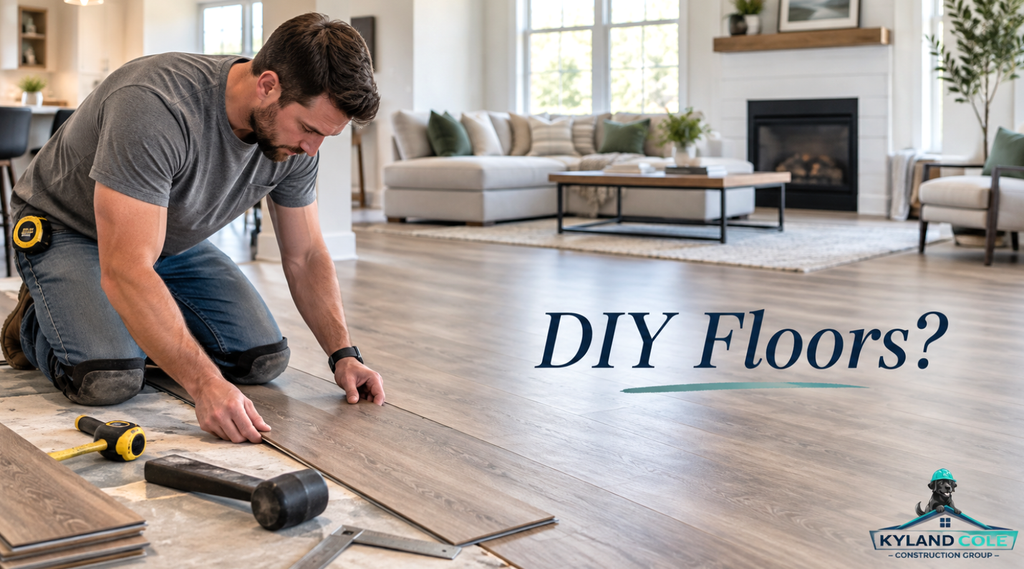
Should you install your own LVP floors? DIY floors seem to be a common trend these days to “Save Money,” but are you really saving money (don’t forget about time) if you are a DIY flooring person in NOVA?
There is a YouTube tutorial paused on your phone and a stack of click-lock planks in the garage, and you are running the numbers: skip the installer, pocket a couple grand.
We get it, it is a fair thought, and sometimes it is the right one. Here is the straight version of DIY flooring vs. professional install. You genuinely can lay a floating floor in a simple room and save real money, but the savings shrink fast once you count tools, waste, and time, and the floors most people itch to tackle, hardwood and tile, are exactly where doing it yourself goes sideways. The deciding factor is not your ambition. It is what sits under the floor.
DIY Flooring Pros and Cons: Quick Summary
DIY flooring can absolutely make sense for the right homeowner and the right room. The biggest question is not whether you are handy enough to install flooring, but whether the subfloor, flooring material, layout, and room conditions make the project DIY-friendly.
| DIY Flooring Pros | DIY Flooring Cons |
|---|---|
| Can save money on installation labor | Installation mistakes can quickly erase the savings |
| Floating LVP and laminate can be beginner-friendly | Subfloor problems may be difficult to identify before installation |
| You can complete the project on your own schedule | A weekend project can easily turn into several weeks |
| Good option for small, simple rooms | Stairs, doorways, transitions, and multi-room layouts require precision |
| Doing your own demolition can reduce project costs | Additional tools, wasted flooring, and materials add to the final cost |
| Gives experienced DIY homeowners more control over the project | Improper installation may affect manufacturer warranty coverage |
| Can work well when the existing subfloor is already flat and dry | Uneven floors, moisture issues, or damaged plywood can require professional preparation |
For Northern Virginia homeowners, the condition of the existing subfloor deserves particular attention. Older homes throughout Warrenton, Haymarket, Gainesville, Bristow, Manassas, and surrounding communities may have plywood movement, uneven areas, previous renovations, or other conditions that need to be corrected before new flooring is installed.
DIY Flooring vs Contractor Installation: The Honest Cost on New Floors DIY
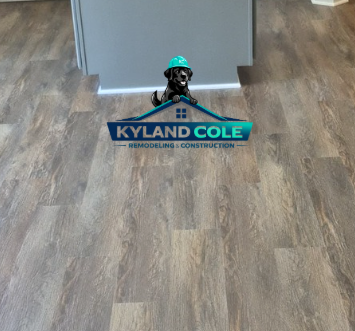
Start with the number that pulls people toward DIY, because it is real. Doing your own luxury vinyl plank saves roughly $1.50 to $5 per square foot in labor. On a 500-square-foot living room, that is $750 to $2,000 in apparent savings, which is nothing to wave off.
Now watch that number shrink. Tool rental or purchase runs $50 to $150 for the tapping block, pull bar, and a saw you may use once. First-time installers routinely waste 15 to 20% of their material on measurement and cutting errors, against the 10% a pro plans for, and on mid-grade LVP that overage eats real dollars. You also lose the installer’s labor warranty, and you become your own crew: a skilled team lays 400 to 600 square feet a day, while most DIYers spend three times longer than they planned, turning a weekend into a month of evenings on your knees. None of that shows up in the sticker math, but it is all part of the price.
Here is the part that stings most. If you get a step wrong, the fix is not cheap. Correcting a subfloor problem after the floor is down runs $3 to $8 per square foot, and choosing the wrong installation method for the room can mean tearing it all out and starting over. That $2,000 you saved evaporates the moment one room needs a redo.
Run the real math on that 500-square-foot room. Call it $1,500 in saved labor at the middle of the range. Subtract $120 for tools, then another $150 or so in extra material lost to beginner waste, and you are closer to $1,230 before you have charged yourself a dime for your time. Now add a single undetected dip in the subfloor that telegraphs through the planks, and the repair alone can swallow what is left. The savings are real. They are also thinner and far riskier than the headline number makes them look.
The part nobody budgets: your time and your body
Flooring is physical work, and the sticker math never charges you for it. Moving 1,000 square feet of planks from the driveway into the house is close to two tons of material carried by hand, one box at a time. Then you spend day after day on your knees, and the $15 knee pads from the hardware aisle tend to slip and cut off your circulation, which is exactly why installers spend $100 on medical-grade gel pads. By the second afternoon, your back is finished, and tired hands make tired mistakes: a skipped moisture reading, a rushed cut, a plank forced into place instead of seated properly. A pro crew clears a room in a day. The same job stretched across your evenings is a month of your life you do not get back, and the exhaustion itself becomes a failure mode.
Which floor are you actually installing?
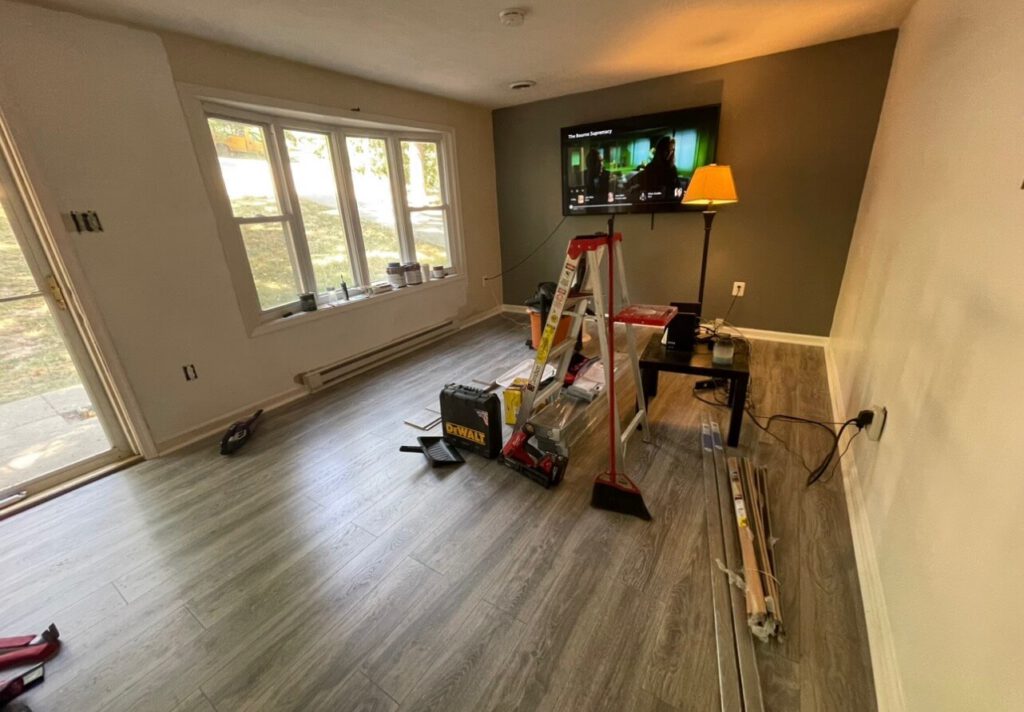
This is the question that decides everything, and it is the one the “you can totally DIY this” videos skip. The honest split is not brave homeowner versus lazy one. It is which material, over which subfloor, in which room. Some floors are genuinely forgiving. Others punish every beginner mistake permanently.
| Floor or situation | DIY-friendly? | Why |
|---|---|---|
| Floating LVP or laminate, flat and dry subfloor, simple square room | Yes | Click-lock planks, no adhesive, mistakes are recoverable |
| Glue-down LVP | Risky | Adhesive is unforgiving, and a crooked plank is set for good |
| Solid or engineered hardwood (nail-down) | Rarely | Needs a flooring nailer, moisture control, and layout skill |
| Ceramic or porcelain tile | Rarely | Mortar, thinset, waterproofing, and lippage control, all slow |
| Stairs | No | Precise cuts, code-driven nosings, and constant visibility |
| Any wet room (bathroom, kitchen) | No | Moisture detailing where a leak means a rebuild |
| Multi-room continuous run | No | Transitions and alignment have to hold across the whole floor |
| Uneven or concrete subfloor | No | Requires leveling and documented moisture testing |
Read that table honestly against your own project. A single square bedroom with click-lock vinyl over sound plywood is a reasonable weekend job. A tile bathroom, a hardwood living room, or anything on a concrete slab is a different sport, and the gap between the two is where most DIY regret lives.
The subfloor is where DIY floors fail
Ask any installer what actually kills a floor, and it is almost never the plank. It is what is underneath. The finished floor is the easy part. Reading and correcting the subfloor is the craft, and it runs on standards most homeowners have never heard of.
| Prep step | The standard | Why it matters |
|---|---|---|
| Flatness | 3/16 inch over 10 ft (floating and glue-down); 1/4 inch over 10 ft (nail-down), per NWFA | Hollow spots, popping locks, a floor that flexes underfoot |
| Concrete moisture | At or below 75% RH (ASTM F2170), or 3 lb (ASTM F1869) | Rising slab moisture buckles boards and rots adhesive months later |
| Acclimation | 48 to 72 hours at living conditions, verified by meter | Boards that skip it gap or buckle after installation |
| Grade level | Solid wood not recommended below grade | Basement moisture destroys solid hardwood over time |
A professional checks flatness with a straightedge and grinds high spots or fills low ones to spec, tests the slab before committing a single board, and confirms acclimation with a moisture meter instead of the calendar. Most first-time installers never measure any of it, which is precisely why their floors develop the waves, gaps, and hollow spots that show up a season later.
Our two markets make this bite in opposite ways. Coastal Georgia, where we work in Pooler, Savannah, and Guyton, is humid year-round; much of Pooler sits on filled, low-lying ground, and slab-on-grade construction is everywhere, so moisture testing is not a formality here; it is the step that decides whether the floor survives. Up in Northern Virginia, the older homes across Warrenton, Haymarket, and the surrounding counties bring the opposite problem: decades-old subfloors that have gone out of level and are bouncy, which is exactly the condition a straightedge and a bag of leveling compound exist to fix before anything goes on top.
What a floor mistake actually costs you
Money is only half of it. A botched paint job you repaint. A floor is different, because you walk on it every single day, in the light, and a wavy seam or a lippy tile row is a permanent, visible reminder in the busiest room in the house. That is the real reason to think twice.
The warranty stakes are concrete, too. Manufacturers write their coverage around documented installation, acclimation, moisture readings, and flatness, and a self-install with no paper trail can void the product warranty entirely. Hire it out, and you get two layers of protection: the manufacturer’s warranty plus the installer’s workmanship warranty, so if something moves, someone other than you owns the fix.
It helps to be clear about what that labor line on the estimate is actually buying. You are not just paying someone to snap planks together, which is the easy part anyone can watch on a screen. You are paying for the judgment that comes before the first board: diagnosing a subfloor, deciding whether it needs grinding, patching, or a full leveling pour, testing and mitigating slab moisture, planning the layout so the pattern lands right and the seams fall where they should, and cutting the waste factor down from a beginner’s 20% to a crew’s 10%. That expertise is invisible in the finished floor, which is exactly why it is so easy to undervalue until a DIY floor makes the case for you.
As one of our project leads tells homeowners weighing it: “The floor is the one surface you cannot fake. You see it in every light, every day. Do the boring part right, test the slab, flatten the subfloor, and the pretty part takes care of itself. Skip it, and you will stare at that mistake for ten years.”
When DIY genuinely makes sense, and when to call us:
None of this means never pick up a tapping block. There is a real DIY window, and there is an honest line past it.
- Good DIY candidates: a small bedroom, office, or closet; a simple rectangular room with no stairs and few doorways; floating click-lock LVP or laminate; and a subfloor you have confirmed is flat, clean, and dry.
- Call a professional for: hardwood, tile, and stone; stairs; bathrooms, kitchens, and anything below grade; glue-down installations; large or multi-room open layouts; any concrete slab; and any job where the manufacturer’s warranty depends on documented steps.
- Split the difference to save smart: do the demolition yourself. Ripping out and hauling old carpet or tile can shave $0.50 to $2 per square foot off the bill, and it is the part that needs muscle, not precision, so you keep the savings and hand the exacting work to a crew. Clearing your own furniture and buying the material yourself trims the number further, without putting the finished floor at risk.
One more money move that beats DIY on many jobs: get three quotes. Homeowners who compare at least three bids pay about 15% less on average than those who take the first number, per HomeAdvisor data, which often narrows the pro-versus-DIY gap more than swinging the hammer yourself would. Book in the off-season, roughly November through February, and many crews trim their rates another 10 to 20% when their calendars are light.
The bottom line on DIY flooring vs professional
Doing your own floors is a smart move on a narrow set of jobs: floating vinyl or laminate, a simple room, a subfloor you have verified, and a genuine miscalculation everywhere else, especially hardwood, tile, wet rooms, and anything over concrete. The savings look bigger on paper than they end up being, and the subfloor, not the plank, is what decides whether the floor lasts or fails.
The smartest first step costs you nothing: have someone look at your subfloor and your specific room before you buy a single box, because that read tells you honestly whether this is a weekend project or a call. Homeowners across Warrenton, Gainesville, Haymarket, and Bristow in Virginia, and in Pooler, Savannah, and Guyton in Georgia, can reach Kyland Cole Construction Group at 571-921-2325 for that assessment and a straight recommendation, DIY or not.
Northern Virginia Flooring FAQs
1. Is LVP flooring a good option for homes in Bristow, VA?
LVP flooring is a great option for many Bristow homeowners because it is durable, relatively easy to maintain, and available in styles that work well in both newer and established homes. Floating click-lock LVP can also be one of the more DIY-friendly flooring options when the existing subfloor is flat, clean, dry, and structurally sound.
The important part is checking the floor underneath before installation. Uneven plywood, damaged subfloor sections, or poorly prepared transitions can create movement, gaps, or premature wear in otherwise good LVP flooring.
2. Should I install my own flooring in Gainesville, VA?
DIY flooring can make sense in Gainesville when you are working with a smaller rectangular room, floating LVP or laminate, and a subfloor that does not require significant preparation. Bedrooms, offices, and closets are generally much easier DIY projects than large open-concept areas.
For stairs, bathrooms, multiple connected rooms, hardwood, tile, or floors with noticeable movement or unevenness, professional installation can reduce the chances of expensive corrections later.
3. What flooring problems are common in older Warrenton homes?
Older Warrenton homes can have flooring challenges that aren’t immediately visible once carpet or an existing floor covers the subfloor. Plywood can become uneven, previous renovations may have created different floor heights, and certain areas may develop movement or low spots over time.
Before installing new flooring, inspect the existing surface for flatness, damaged material, moisture concerns, and structural movement. Correcting those problems before installation is usually much easier than removing a newly installed floor later.
4. Is DIY flooring a good idea for homes in Haymarket, VA?
DIY flooring can work well in Haymarket homes when the project is straightforward, and the homeowner is using a forgiving product such as click-lock LVP or laminate. A single bedroom or office with a level subfloor can be a reasonable project for an experienced DIY homeowner.
Large first-floor layouts, stairs, kitchens, bathrooms, hardwood, and continuous flooring running through several rooms require considerably more planning. Layout, transitions, cuts, and subfloor preparation become increasingly important as the project gets larger.
5. How much can I save installing floors myself in Manassas or Northern Virginia?
The biggest potential DIY savings come from eliminating professional installation labor. However, Northern Virginia homeowners should compare those savings against tool purchases or rentals, extra material waste, demolition, disposal, subfloor repairs, and the personal time required to finish the project.
One of the best ways to reduce costs without taking on the entire installation is to handle simpler portions of the project yourself. Removing old carpet, moving furniture, or handling disposal can cut labor costs while letting a professional installer handle subfloor preparation, layout, cutting, transitions, and the final installation.
Need Help With Your Northern Virginia Flooring Project?
Not sure whether your floor is a good DIY project or one you should hand off? Kyland Cole Construction Group helps homeowners throughout Warrenton, Gainesville, Haymarket, Bristow, Manassas, Prince William County, Fauquier County, and surrounding Northern Virginia communities with flooring installation and home improvement projects.
Call 571-921-2325 to discuss your flooring project and get a straightforward recommendation based on your home’s actual condition.