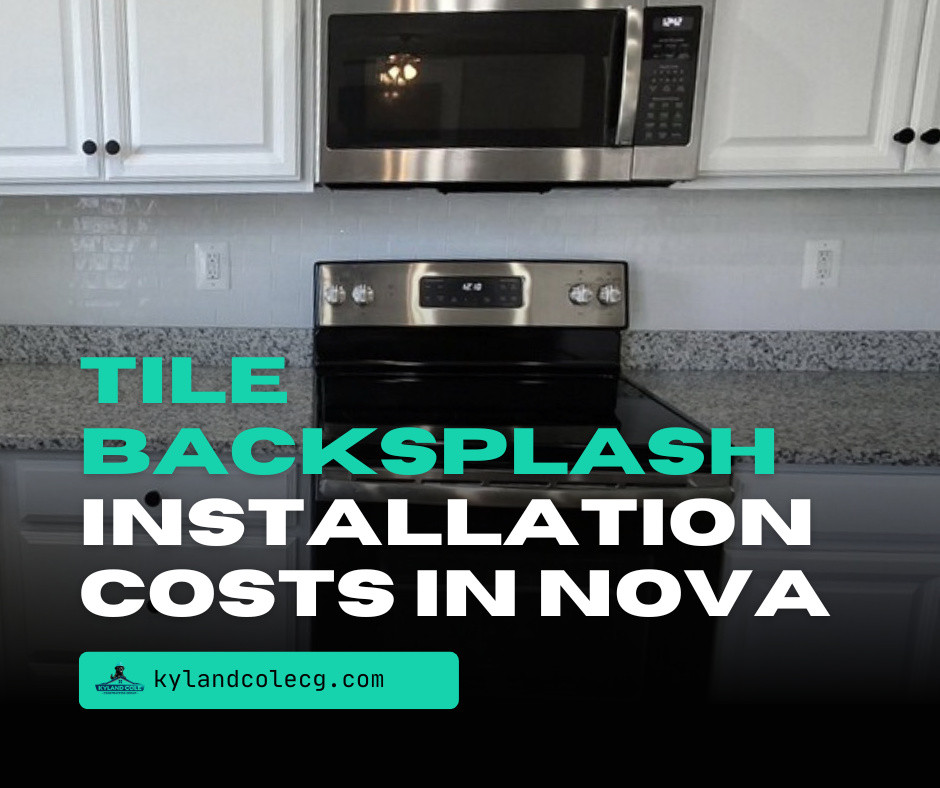
How much does a new backsplash cost? We get this question quite often, to be honest, and if you haven’t looked on ChatGPT yet, don’t worry, we can provide you with the tile backsplash cost answers below!
Two homeowners on the same street, both wanting “white subway tile,” can get backsplash quotes that differ by $600. Same tile. Same-size wall. The gap is everything the tile box doesn’t show you. Backsplash installation cost runs $500 to $1,700 for a typical kitchen, or roughly $10 to $50 per square foot installed, and the material is usually the small part of that number.
I’ve set tile in NOVA kitchens and Pooler remodels for years, and the question I get most isn’t “what does it cost,” it’s “why is my quote higher than my neighbor’s.” Let me show you exactly where the money goes.
How much does a kitchen backsplash cost to install?
For a standard kitchen, plan on $500 to $1,700 all in, materials and labor. A typical backsplash covers around 30 square feet, the strip between your countertop and upper cabinets, and most projects land near $650 to $1,000 once you’ve picked a sane material and a simple pattern. National cost guides put the installed range at $10 to $50 per square foot, with labor alone running $5 to $20 per square foot and materials anywhere from $1 to $65, depending on what you fall in love with.
That range is wide for a reason, and it’s not the reason most people think. The tile is rarely what blows the budget. One renovation breakdown nailed it: a backsplash is one of the cheapest surfaces in a kitchen and one of the most visible, and the difference between the cheapest defensible choice and the most expensive one is often about $2,000 on a 30-square-foot run. That two grand might buy a dramatically better kitchen, or a marginal upgrade you stop noticing in six months. Your call. But you should make it knowing what’s driving the number.
Why do two quotes for the same backsplash differ so much?
Labor and prep. That’s the short answer. The tile price is fixed once you’ve chosen it, but the hours on the wall swing hard based on what’s behind the tile and how complicated the pattern is. Here’s what actually moves a quote, and most of it never shows up in an online calculator:
1. Wall condition and prep.
A flat, clean, freshly skim-coated wall is fast. A wall with old adhesive, grease film, wallpaper residue, or dips that need floating is slow, and skim coating or leveling is billable time before a single tile goes up.
2. Tear out the old backsplash.
Removing and hauling away existing tile adds $2 to $6 per square foot and often damages the underlying drywall, which then needs patching.
3. Outlets, switches, and the range area.
Every outlet means precise cuts and box extenders so the cover plates sit flush over the new tile surface. A wall with six outlets takes far longer than a blank one, and getting the pattern to line up across each cut is where amateurs lose the plot.
4. Edge finishing.
How you end the tile at an open edge, with a metal Schluter trim, a bullnose tile, or a mitered corner, changes both material and labor. Schluter edging commonly adds around $100 to a job.
5. Local labor rates.
Urban and high-cost areas run higher than suburban ones. A backsplash in Arlington or Vienna will usually be priced higher than the same job in Pooler because NOVA labor rates are simply higher than those in coastal Georgia.
A small aside that surprises people: tiny jobs sometimes cost more per square foot, not less. A 12-square-foot run still requires a tradesperson to load up, drive out, set up, and come back two days later to grout. That minimum-trip overhead gets spread across fewer feet, so the per-foot rate climbs.
How much does the material itself cost?
Here’s the honest material picture, separated from labor so you can see where your money goes. These are installed ranges, which fold in the labor that each material demands, because a cheap tile that’s a nightmare to cut isn’t actually cheap.
| Material | Installed cost / sq ft | What you’re getting | The catch |
|---|---|---|---|
| Ceramic / porcelain subway | $10 to $25 | Durable, classic, easy to clean, easy to set | Hard to make boring tile look custom |
| Natural stone (marble, travertine, slate) | $15 to $65 | Warmth and one-of-a-kind veining | Needs sealing; slow to cut and level; ongoing upkeep |
| Glass tile | $20 to $60 | Light, depth, color | Cracks and chips if cut wrong; precise, slow work |
| Metal/stainless | $20 to $50 | Modern, wipeable | Dents; limited looks |
| Mosaic sheets | Varies widely | Detail without setting each piece | Sheet seams telegraph if not feathered carefully |
Tile backsplash installation cost climbs fastest not with the prettiest tile, but with the hardest to install. Glass and natural stone both punish a rushed installer. Glass shows every imperfect cut and can fracture under a bad score. Stone has to be leveled, sealed, and handled with more care, which is why labor on stone routinely runs $15 to $45 per square foot on its own.
The factor nobody quotes you on: the pattern
This is the single biggest swing in a backsplash budget, and it’s the information most cost guides bury. The layout pattern can double your labor on identical tile.
A straight subway run in a standard running bond is fast. A herringbone or intricate mosaic is a different animal. Industry labor data shows a standard subway backsplash of about 30 square feet takes a pro 5 to 7 hours, while a herringbone of similar size takes 10 to 14 hours, roughly double. The reasons are simple once you’ve cut them: herringbone is all angled cuts, which means more measuring, more waste, and more grout joints to keep consistent.
Pattern complexity alone can push labor from around $10 per square foot to $35 or even $50, and contractors often switch to a day rate (up to $500 a day) for detailed pattern work because hourly stops making sense.
| Pattern | Relative labor | Why |
|---|---|---|
| Straight / stacked | Lowest | Few cuts, fast alignment, minimal waste |
| Running bond (classic subway) | Low | Standard, predictable, one-day job for 30 sq ft |
| Vertical or chevron | Moderate (about 25 to 50% more) | More cuts and alignment fussiness |
| Herringbone | High (roughly double) | Angled cuts, high waste, many joints |
| Detailed mosaic | High and variable | Sheet feathering, edge work, slow detail |
So if your budget is tight but you want impact, the move I give clients is to keep a simple pattern in a quality tile, rather than a fancy pattern in a cheap one. The pattern is where your labor dollars vanish. Spend them on purpose.
Top Backsplash Mistakes Most Homeowners Make
The biggest errors I get called to fix aren’t about taste. They’re about the stuff behind and around the tile that nobody thinks about until it fails. Not to mention, poor installation and cuts in a tile backsplash are often an eyesore.
Here are the five backsplash mistakes we see that cost owners the most:
Skipping waterproofing behind the wet zones.
Grout is not waterproof. Behind a sink or faucet, water finds the seams, slips behind tile set on bare drywall, and the wall softens, swells, and grows mold in the dark. For most dry runs, standard drywall is fine and code-acceptable. But behind a wet zone, or in a humid coastal kitchen like the ones we work in around Savannah and Pooler, that tile wants a proper substrate and waterproofing, the same cement backer board the bathroom-tile world has used for years. As our owner puts it: “People pay for the tile they can see and skip the wall they can’t. Then they call me to fix the wall. Do it once.”
Tiling over the old backsplash instead of removing it.
It’s technically possible, and it’s almost always the wrong call. Layering new tile over the old one builds a thick, bulky wall edge and invites adhesion problems down the line. Pay for the tear-out. A clean substrate is worth more than the few hundred dollars you’d save by skipping it.
Ordering exactly the square footage you measured.
Always add about 10 percent for breakage and cuts, and more for angled patterns like herringbone that waste tile at every edge. Run short mid-job and you’re waiting on a second order, risking a dye-lot mismatch, with your kitchen stalled in the meantime.
Chasing a fancy pattern on a tight budget.
The layout is where labor dollars vanish, so a herringbone in cheap tile often costs more to install than a simple run in a nicer one. If money’s limited, buy a quality tile and set it straight. Spend the budget on the material you’ll touch, not the angles you’ll stop noticing.
Treating grout and sealing as set-and-forget.
Natural stone needs sealing, and every grout joint is a maintenance line that stains and darkens if it’s ignored. A detailed mosaic or herringbone has far more joints to keep up than a clean subway run, so factor the upkeep into the look you pick, not just the install price.
Should you DIY a backsplash or hire a pro?
A straight subway backsplash on a clean, flat wall is one of the more DIY-friendly tile jobs out there, and doing it yourself saves roughly $10 to $15 per square foot in labor, which is real money on a 30-foot run. If you’ve got patience, a decent tile cutter or wet saw, and a free weekend, a simple layout is achievable.
The honest tradeoffs. Outlet cuts, keeping a level pattern across a long run, and finishing the edges cleanly are where first-timers struggle, and a wavy grout line or a lippy tile is visible at eye level forever. Hire out when the pattern is complex, the wall needs real prep, there’s stone or glass involved, or the backsplash runs behind a sink where waterproofing matters. A peel-and-stick product is a genuine budget path for a rental or a quick refresh, but it won’t read as real tile up close, and it won’t protect a wet wall the way set tile does.
So What Should You Budget for Your Backsplash?
For a typical kitchen, expect $500 to $1,700, with most simple-pattern jobs in quality tile around $650 to $1,000. The tile is the cheap part. Labor, your pattern, and the wall behind the tile are the real spend.
Before you call anyone, measure your run, pick a pattern, and count the outlets. Ask any installer for prep, tile, and pattern labor as separate lines, not one lump sum. That’s how you tell a real bid from a guess. In Northern Virginia, Savannah, or Pooler, call Kyland Cole Construction Group at 703-887-7584 or just reach out to us below!