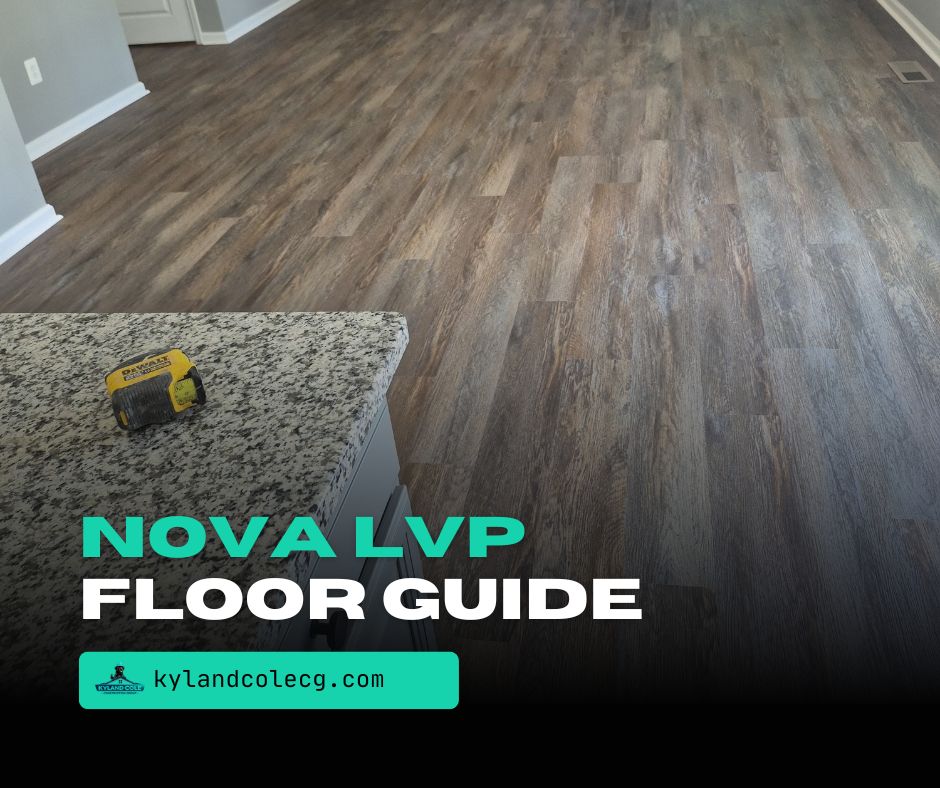
How do you know when LVP floors are the right fit for your home?
A client in Vienna called me last spring because her year-old vinyl floor had buckled into a low ridge right where the afternoon sun hit it through a big west-facing window. The floor wasn’t defective. The install was. That story is the short answer to whether LVP flooring in Northern Virginia is a good idea: yes, it usually is, but only if the spec and the installation account for how these floors actually behave in our climate.
This LVP Flooring Guide for Northern Virginia is the version I’d give a friend, with the real costs, the spec that matters, and the parts the sales floor skips.
Bonus: LVP means luxury vinyl plank!
Is LVP a good choice for a Northern Virginia home?
LVP floors are the best option for most NOVA homes, ranging from townhouses to single-family homes with finished basements and busy households with kids and dogs. LVP earns its spot because it handles moisture and traffic better than hardwood or carpet at a lower price. It’s the most-installed flooring category in North America right now, and that popularity is earned, not hyped.
But “good choice” depends on the room and the product, not the category. I’ve put rigid-core vinyl in basements that flood-scared their owners for years and never had a callback. I’ve also pulled up cheap LVP that gapped and lifted within a season because someone bought on plank thickness and sun exposure did the rest. The material is rarely the problem. The decision around it usually is.
What does LVP flooring cost in Northern Virginia?
Installed, most NOVA projects land between $5 and $12 per square foot, with materials running roughly $2 to $10 and professional installation adding about $2 to $6. National cost guides put luxury vinyl at $4 to $16 per square foot installed across all tiers, and the average whole-home job (around 1,500 square feet) runs somewhere near $9,000 to $12,000 fully installed.
The spread is real, and it tells you something: products labeled “LVP” exist at $2 and at $10 per square foot, and the difference in what you actually get is large. Here’s how the tiers break down in practice.
| Tier | Material / sq ft | Typical wear layer | Best for |
|---|---|---|---|
| Budget | $2 to $3 | 6 to 12 mil | Rentals, guest rooms, low-traffic spaces |
| Mid-range | $3 to $6 | 12 to 20 mil | Most NOVA family homes, main living areas |
| Premium | $6 to $10+ | 20 mil and up | High-traffic homes, big dogs, heavy sun, long-term holds |
A few line items the online calculators leave out, and that I itemize on every LVP floor quote:
- Subfloor prep and leveling. This is the most common surprise cost. A floating floor telegraphs every dip and hump in the subfloor, and leveling compound, sanding, or board replacement is real labor before a single plank goes down.
- Tear-out and disposal. Pulling old carpet, tile, or glued-down vinyl, plus hauling it away, is rarely in the per-square-foot number you see advertised.
- Transitions and trim. Doorway transitions, stair nosings, and quarter-round at the baseboards add up fast in a home with a lot of rooms, which describes most NOVA floor plans.
- Stairs. If your project includes a staircase, price it separately. Stairs are slow, exacting work and they’re priced per tread, not by the square foot.
Having Kyland Cole help install new LVP floors in our Manassas home helped update it before we sold it! We would recommend them and their floor team to anyone in Northern Virginia!” ~Laura G.
The spec that actually matters: wear layer, not plank thickness
If you take one thing from this guide, make it this. Most people shopping LVP fixate on total plank thickness (the millimeter number), and that’s the wrong number. The number that decides how long your floor looks good is the wear layer, measured in mils, which is the clear protective coating on top.
The two get confused constantly, partly because one is in millimeters and one is in mils (a mil is a thousandth of an inch, not a millimeter).
A thick 8mm plank with a thin 6-mil wear layer will scratch and dull faster than a thinner plank with a 20-mil layer. As one flooring guide put it bluntly, buying on plank thickness instead of wear layer is like picking a helmet for its color and padding while ignoring the impact rating. The thickness below the wear layer does nothing for scratch and fade resistance.
Here’s the practitioner rule of thumb, backed by industry standards:
| Wear layer | Where it belongs | Notes |
|---|---|---|
| 6 to 8 mil | Closets, guest rooms, low-traffic only | Entry-level; don’t put it where life happens |
| 12 mil | Standard residential, moderate traffic | The common “good” tier for living rooms and hallways |
| 20 mil | Active families, big pets, heavy sun, light commercial | My default recommendation for main NOVA living spaces |
| 28 to 30+ mil | Commercial and very high traffic | Overkill for most homes; can mute the visual detail |
Industry sources are consistent here: 12 mil is the standard for moderate residential traffic, while 20 mil and up is what you want for active homes with kids, large dogs, or strong sun exposure. Doubling the wear layer roughly doubles the floor’s usable lifespan, which is why the warranty tracks the wear layer almost directly.
A 12-mil residential floor commonly carries a 20-year warranty; thinner layers carry shorter terms. If a salesperson can’t tell you the wear-layer mil off the spec sheet, slow down.
Why “waterproof” is the most misunderstood word in the category
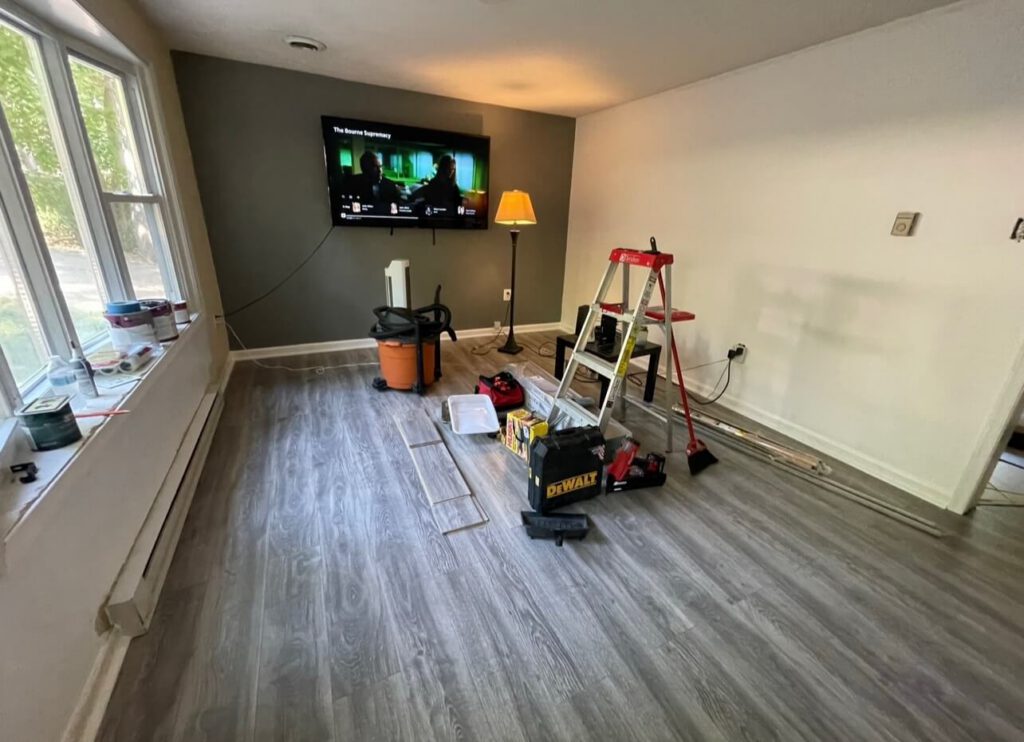
Every LVP box says “waterproof,” and the plank is, too. The floor isn’t. That distinction has saved my clients real money, and ignoring it has cost others a subfloor.
A click-lock LVP floor floats over the subfloor with seams between every plank. The vinyl itself won’t absorb water, true. But standing water from a dishwasher leak, a pet accident left overnight, or a slow supply-line drip works through those seams, pools on the subfloor underneath, and has nowhere to evaporate. What you get is a trapped-moisture problem: subfloor swelling, adhesive issues on glue-down installs, and mold growth in the dark space under a floor that looks perfectly fine on top. Even waterproof LVP can be undermined when water seeps beneath the planks and sits.
So waterproof means the floor survives a wiped-up spill and a wet mop. It does not mean you can ignore a leak because “the floor’s waterproof.” In a NOVA basement, where slab moisture is the bigger threat, the right move is to test the slab and address vapor before installing, not to trust the marketing word on the box.
The Northern Virginia angle: temperature swings and basement moisture
This is the part a national flooring blog can’t tell you, because it doesn’t know you live somewhere that goes from 20 degrees in January to 95 degrees and swampy in July. Two NOVA-specific realities drive most of the LVP failures I get called to fix.
Heat and sun expansion
Vinyl moves with temperature. It expands when warm and contracts when cold, and the movement, while small per plank, adds up across a room. The practical danger zones are direct sun and big temperature swings. High temperatures (generally above 80 degrees Fahrenheit) cause LVP to expand; below 65, it contracts. A west or south-facing room with large windows or a sliding glass door acts like a magnifying glass, heating one strip of floor while the rest stays cool, and that uneven expansion is exactly what buckled my Vienna client’s floor.
Two things prevent it, and both are install-quality issues, not product issues:
- Acclimation. The planks need to sit in the actual room, boxes open, for at least 48 hours before install so they stabilize to that room’s temperature and humidity. Skipping this to finish a day early is the single most common shortcut I see, and it’s the root of most gapping.
- Expansion gaps. A floating floor needs a perimeter gap, typically a quarter inch for rooms under 50 feet, increasing to a half inch for spans between 50 and 85 feet. The baseboard or quarter-round hides it. Installers who butt the planks tight to the wall to avoid cutting trim are building in a future buckle.
A core-type note that matters here: SPC (stone-polymer composite) cores are more dimensionally stable under temperature swings than the softer WPC (wood-polymer composite) cores. WPC feels warmer and quieter underfoot, which people love, but in a sunroom or a room with strong west sun, I lean toward SPC for stability.
If you’re running radiant heat under the floor, keep the surface temperature under about 85 degrees, or you’ll cook the same expansion problem into the system on purpose.
Basement and slab moisture
A large share of NOVA homes have basements, and concrete slabs emit moisture vapor for a long time, sometimes for years after the pour. LVP over a damp slab without a moisture barrier invites adhesive failure and trapped moisture problems. Before we install over concrete, we check the slab’s moisture condition and add the right underlayment or vapor barrier. It’s an unglamorous step that doesn’t show up in a glossy quote, and it’s the difference between a basement floor that lasts and one that lifts.
As we like to tell clients: “The floor you see is only as good as the subfloor you don’t. We spend more time on what’s underneath than on the planks, because that’s what actually fails.“
LVP versus hardwood and tile: what wins where in NOVA
LVP isn’t automatically the right answer, and in a high-value Northern Virginia market, resale is a fair thing to weigh.
| Floor | Strengths | Weak spots | NOVA verdict |
|---|---|---|---|
| LVP | Water-resistant, durable, pet and kid friendly, lower cost | Can dent under heavy point loads, lower resale prestige than wood | Best for basements, kitchens, busy family levels |
| Solid/engineered hardwood | Resale value, refinishable, classic look | Hates moisture, scratches, costs more | Best for formal main levels in higher-end homes |
| Porcelain tile | Nearly bulletproof with water, very durable | Hard and cold underfoot, grout upkeep | Best for bathrooms, mudrooms, entry from the garage |
In a $1.2 million single-family home in McLean or Great Falls, real hardwood on the main level still carries resale weight that vinyl doesn’t, and I’ll say that even though it’s a smaller job for us. In a townhouse, a rental, or a basement anywhere in the region, LVP is usually the smarter spend. The right floor depends on the room and the house, not on which material is trending.
One more honest note on indoor air quality, since families ask: lower-quality vinyl can contain phthalates or off-gas volatile organic compounds. If that matters to your household, look for products with low-VOC or FloorScore-type certification and buy from an established manufacturer rather than the cheapest no-name box. It’s a small filter that removes most of the risk.
So, is LVP flooring right for your Northern Virginia home?
For most rooms in most NOVA homes, LVP flooring is a smart, durable, sensible choice, as long as you buy on wear layer rather than plank thickness, treat “waterproof” as splash protection rather than leak insurance, and hire someone who acclimates the planks, leaves real expansion gaps, and checks your subfloor before the first board goes down. Get those right, and you’ll forget about the floor for fifteen to twenty years, which is exactly what you want from a floor.
The concrete next step: before you shop, decide which rooms are getting LVP versus hardwood or tile, then ask any installer to quote the wear-layer mil and the subfloor prep as separate line items. That one request filters the pros from the order-takers. If you’re in Northern Virginia and want that walkthrough done right, call Kyland Cole Construction Group at 571-921-2325, and we’ll spec it for your house, not for a catalog.
Frequently Asked Questions About LVP Flooring in Warrenton, Gainesville, Haymarket, Bristow, and Manassas
1. Is LVP flooring a good choice for homes in Warrenton, VA?
LVP flooring is a great option for Warrenton homeowners because it works well in basements, kitchens, family rooms, bedrooms, and other high-traffic areas. For homes with children, pets, or finished basements, we typically recommend a quality LVP with at least a 12-mil wear layer, with 20 mil being our preferred option for heavily used living spaces.
The condition of the subfloor is just as important as the flooring itself. Before installing LVP in a Warrenton home, the floor should be checked for uneven areas, moisture, damaged plywood, and other conditions that could cause the new flooring to move or separate.
2. How much does LVP flooring cost to install in Warrenton or Gainesville?
LVP flooring installation in Warrenton and Gainesville typically ranges from $5 to $12 per square foot, depending on the flooring selected, existing flooring removal, subfloor preparation, trim, transitions, stairs, and the overall complexity of the project.
A straightforward Gainesville flooring replacement may cost considerably less than a project requiring tile demolition, extensive leveling, new baseboards, stair work, or plywood repairs.
Kyland Cole Construction Group recommends getting a quote based on the actual condition of your home rather than relying solely on an advertised square-foot price.
3. What type of LVP is best for homes in Gainesville, VA?
For most Gainesville homes, a rigid-core LVP with a 12-mil to 20-mil wear layer is an excellent choice. A 20-mil wear layer is particularly well suited for busy households with children, dogs, frequent entertaining, or heavily traveled main living areas.
SPC rigid-core flooring can also be a strong option for rooms that experience significant temperature fluctuations or direct sunlight due to its dimensional stability.
The best product ultimately depends on where the floor is being installed, the condition of the subfloor, the amount of sunlight the room receives, and how heavily the room is used.
4. Is LVP a good flooring option for a Haymarket basement?
LVP flooring is one of our preferred flooring options for finished basements in Haymarket and throughout Northern Virginia because it offers durability, easy maintenance, and strong resistance to everyday moisture.
However, the fact that LVP is marketed as waterproof does not mean moisture underneath the flooring can be ignored. Concrete basement slabs can transmit moisture vapor, so the slab and installation conditions should be evaluated before the flooring goes down.
Depending on the flooring manufacturer and existing conditions, the installation may require an approved vapor barrier or underlayment. Proper preparation underneath the flooring is one of the most important parts of a successful basement LVP installation.
5. Is LVP a good flooring option for Bristow homes with kids and dogs?
LVP floors are a great option for Bristow families with kids and dogs because they are durable, relatively easy to clean, and more resistant to everyday spills and moisture than traditional hardwood.
For homes with larger dogs, children, or high-traffic living areas, we generally recommend choosing a 20-mil wear layer rather than choosing flooring based solely on the overall thickness of the plank.
The wear layer is the protective surface that helps the flooring resist scratches and everyday wear, making it one of the most important specifications to compare when shopping for LVP.
6. Can LVP be installed throughout an entire Manassas home?
LVP can work very well throughout many Manassas homes, including kitchens, living rooms, hallways, bedrooms, basements, and connected open-concept spaces.
That does not necessarily mean LVP should be installed in every room. Bathrooms with tubs and showers require additional consideration because water can potentially travel through seams or around the perimeter of a floating floor. Some homeowners may also prefer tile in bathrooms or hardwood in more formal living spaces.
At Kyland Cole Construction Group, we prefer to evaluate the house room by room instead of automatically recommending the same flooring everywhere.
7. Is LVP flooring really waterproof?
LVP planks are generally highly water resistant or waterproof, but the entire flooring system is not necessarily waterproof.
Water can still travel through plank seams, underneath baseboards, or around the perimeter of the room and become trapped against the plywood or concrete underneath.
That is why homeowners in Warrenton, Gainesville, Haymarket, Bristow, and Manassas should still address dishwasher leaks, plumbing leaks, basement moisture, and standing water quickly even when they have waterproof LVP flooring.
8. Can LVP be installed over concrete in a Northern Virginia basement?
LVP can usually be installed over concrete in Northern Virginia basements, but the condition of the concrete needs to be evaluated before installation.
Before installing LVP over a basement slab, we look for moisture concerns, major cracks, uneven areas, high spots, and low spots. Depending on the flooring manufacturer’s requirements and the condition of the slab, additional moisture protection or leveling may be necessary.
Installing expensive flooring over a poorly prepared concrete slab can lead to movement, gaps, damaged locking systems, and premature flooring failure.
9. Does the subfloor need to be level before installing LVP?
The subfloor needs to be sufficiently flat, solid, and stable to meet the flooring manufacturer’s installation requirements.
One of the biggest misconceptions about floating LVP is that it will simply cover imperfections underneath it. In reality, dips, humps, damaged plywood, loose subflooring, or uneven concrete can eventually cause movement and place unnecessary stress on the click-lock joints.
Subfloor preparation can be especially important in older homes around Manassas and Warrenton where additions, previous flooring installations, or years of remodeling may have created transitions between different floor heights.
10. Can direct sunlight damage LVP flooring in Haymarket or Gainesville homes?
Strong direct sunlight and excessive heat can contribute to expansion, contraction, fading, or movement in some vinyl flooring products.
This is particularly important in Haymarket and Gainesville homes with large south- or west-facing windows, sliding glass doors, sunrooms, and open-concept living spaces that receive hours of direct afternoon sun.
Proper acclimation, manufacturer-approved expansion gaps, appropriate flooring selection, and good installation practices help reduce these risks. For rooms with substantial sun exposure, we may recommend a more dimensionally stable rigid-core product.
11. How long should LVP acclimate before installation in Northern Virginia?
Many LVP products require approximately 48 hours of acclimation, although the flooring manufacturer’s instructions should always be followed.
The flooring should be allowed to adjust to the temperature and conditions inside the home before installation when required by the manufacturer.
Northern Virginia experiences significant seasonal temperature and humidity changes, making it especially important for installers to follow the specific requirements of the flooring being used rather than rushing the installation.
12. Should I choose 12-mil or 20-mil LVP for my Northern Virginia home?
A quality 12-mil wear layer can work well for moderate residential use, while 20-mil LVP is typically our preference for main living areas, families with children, homes with large dogs, rental properties, and other high-traffic spaces.
Homeowners should also remember that the wear-layer rating and overall plank thickness are two different measurements. A thicker plank does not automatically mean it has a more durable surface.
When comparing LVP flooring, ask specifically for the wear-layer specification rather than shopping based only on plank thickness.
13. Is LVP better than hardwood for homes in Warrenton, Haymarket, or Gainesville?
LVP can be the better flooring choice for many Warrenton, Haymarket, and Gainesville homes when durability, moisture resistance, maintenance, and cost are the priorities.
Hardwood can provide a more traditional appearance and may be desirable in higher-end formal living spaces. LVP generally offers better resistance to everyday moisture and easier maintenance, making it particularly attractive for basements, kitchens, family rooms, rental properties, and homes with children or pets.
Rather than asking which flooring is universally better, we recommend choosing the flooring that makes the most sense for how each part of the home is actually used.
14. Can Kyland Cole Construction Group remove my existing flooring before installing LVP?
Kyland Cole Construction Group can handle existing flooring removal, disposal, subfloor preparation, LVP installation, transitions, trim work, and many of the related carpentry items that may be needed during a flooring renovation.
This allows homeowners in Warrenton, Gainesville, Haymarket, Bristow, Manassas, and surrounding Northern Virginia communities to work with one contractor rather than coordinating several different companies for different portions of the project.
15. Does Kyland Cole Construction Group install LVP flooring in Warrenton, Gainesville, Haymarket, Bristow, and Manassas?
Kyland Cole Construction Group provides LVP flooring installation and general remodeling services throughout Warrenton, Gainesville, Haymarket, Bristow, Manassas, and surrounding areas of Northern Virginia.
We can help with the entire flooring process, including removal of existing flooring, evaluating the subfloor, completing necessary preparation, installing the new LVP, and handling related trim and finishing work.
If you’re considering new flooring, call Kyland Cole Construction Group at 571-921-2325 to schedule a walkthrough and get recommendations based on your actual home rather than simply choosing a product off the shelf.